AI jury selection tools can research an entire panel overnight, score prospective jurors, and simulate how a verdict might land. But the technology assists; it doesn't choose. This guide covers what these tools do, where they help, where they risk bias, and what the ABA's recent ethics opinion means for the lawyers who use them.
Ask any of your fellow trial attorneys where a case is won or lost, and a good number will point to a moment before the trial even starts: jury selection. The evidence matters. The witnesses matter. But the twelve people who ultimately sit in the box decide which version of the story they believe — and picking them has always been a mix of preparation, instinct, and luck.
Today, attorneys are using artificial intelligence to research prospective jurors, rank them, and even simulate how a panel might vote before anyone sets foot in the courtroom. What used to take an army of lawyers and jury consultants can now start and end with easily accessible AI research tools.
AI doesn't select your jury, though. It reads, sorts, and surfaces information faster than any human could — but the decision of who to keep and who to strike is still yours. Every peremptory challenge, every judgment call about who stays and who goes, remains the attorney's to make and the attorney's to answer for.
In 2025, the American Bar Association issued an important ethics opinion that applied professional conduct rules to AI in the jury box, and it landed on exactly that point: the lawyers are responsible for what the software recommends.
So before you run a single juror through an algorithm, it's worth understanding what these tools actually do, where they help, and where they can quietly put your case — and your license — at risk.
How is AI used in jury selection?
AI does the research that used to consume a war room and hundreds of billable hours. It scans the digital trail prospective jurors leave behind, organizes what it finds, and turns days of manual digging into something an attorney can review before the panel is even seated.
That work breaks down into three main jobs:
Researching and profiling jurors
Tools like Magna Legal Services' JuryScout and Vijilent's Reveal use web-scraping bots to pull social media posts, public records, and other online data. Once that’s done, the tools apply machine learning and natural language processing to uncover what's relevant to the case at hand — quickly. This is work a team of associates and paralegals might be able to pull off overnight, but it is rarely a job for one person.
Scoring and ranking
Momus Analytics, which claims to be built by trial attorneys and used in more than 200 trials, runs a proprietary algorithm that scores potential jurors and predicts how each one might sway the group's decision-making. The output is a ranked list: your best jurors, your worst, and everyone in between. It's also where the hard questions about how those scores get calculated start to surface.
Simulating the jury
The newest category of AI jury selection tools doesn't just analyze real jurors — it invents them. Platforms like Viewpoints.ai and Jury Simulator create AI "jurors" that read your evidence, deliberate against one another, and return a projected verdict. Attorneys use them to pressure-test arguments and potentially forecast how a real panel in the same venue might react — all at a fraction of what a live mock trial costs.
There’s one practical difference worth knowing, however: some of these come as software you run yourself, others as a service where the provider's team does the work and hands you a report. Research and scoring have traditionally been sold as done-for-you engagements, priced per case. The newer simulation tools lean toward self-service and are priced to undercut a traditional mock trial, which is what puts them within reach of firms and clients who don’t have the six-figure budget to spend on a jury consultant.
In practice, these categories blur somewhat. Several providers now bundle research, scoring, and simulation into one platform, and a full-service jury consultant may use all three behind the scenes. The question isn't which single tool to buy — it's which parts of the work you want a machine to do, and which you still want a human to perform.
Benefits of AI-assisted jury selection
The case for these tools comes down to doing something humans can't: reviewing more information, about more people, in less time, for less money. When it comes to AI for litigators, jury selection is as close to an ideal use case as one could imagine. It’s a narrow, time-boxed task drowning in public data, where the old approach was either heroic manual effort or a pricey consultant. Here's what the technology actually delivers.
Speed
A trial lawyer often gets the venire list the day before selection. AI can research an entire panel overnight. It’s the kind of thorough, whole-panel dig a human team would struggle to finish in under a week, let alone 24 hours.
Breadth
These tools scan social media, public records, and court histories across a full panel at once, revealing connections, past conduct, and attitudes jurors have shared publicly. A manual search would almost certainly miss large swaths of that information. Yet today, that search can run in the background while lawyers and paralegals continue with trial preparation.
Lower cost, wider access
Full-service jury consulting has long run well into six-figures, and a large mock trial can approach half a million dollars. This has traditionally put valuable jury research out of reach for solo practitioners and small firms. AI simulation platforms priced as software close much of that gap, giving a two-person plaintiff’s shop a version of what only BigLaw could once afford.
Strategy testing
Typically, a live focus group tests one version of your case. A simulation lets you run the closing three ways, swap an expert, or lead with a different theme and watch the panel move — as many times as you want, in minutes.
Instinct verification
Jury selection has always leaned on gut feeling and inherited superstition. Used well, data gives attorneys a second opinion — a way to cross-test a hunch about a juror against something other than the same trial team they’ve been working with for months.
All these benefits lead to an obvious question: does any of this actually predict verdicts? Cautiously, the early evidence is encouraging. In a head-to-head test published in DRI's For The Defense in May 2026, a simulated panel and a live human mock jury reached the same verdict on the same case. One result isn't proof (vendors themselves call their numbers "directional" rather than predictive) but it's a real data point where, not long ago, there was only a sales pitch.
Is it ethical to use AI for jury selection?
For years, the ethics of using data tools in voir dire lived in a gray area. That changed in July 2025, when the American Bar Association issued Formal Opinion 517, the first ABA ethics guidance to address AI in jury selection directly.
The foundation of the opinion comes from established law. Under the Supreme Court’s 1986 ruling in Batson v. Kentucky and its progeny, a lawyer cannot use a peremptory challenge based on race or gender. To do so violates the juror's equal protection rights. Model Rule 8.4(g) layers a professional-conduct duty on top of that, barring discrimination in conduct related to practicing law. What Opinion 517 does is apply that settled framework to a new fact pattern: what happens when the recommendation comes from a machine instead of a person?
The answer is that the tool changes nothing about who is responsible. The opinion works by analogy — a lawyer who accepts a client's or a jury consultant's race-based instruction is "knowingly" discriminating. Relying on an algorithm is no different. As the opinion frames it, a program could rank jurors in a way that amounts to unlawful discrimination while offering neutral-sounding reasons for the ranking, and a lawyer who acts on that could commit purposeful Batson discrimination even without the intent to discriminate. The question a court will ask is whether the lawyer "knows or reasonably should know" the strike was impermissible.
Duty of inquiry
This is the part most likely to surprise practitioners. Opinion 517 says a lawyer has a duty to conduct enough due diligence to understand, in general terms, how a jury selection program works — its methodology, its benefits and risks, and its limitations. You can satisfy that by studying the program, bringing in competent co-counsel, or consulting someone with real expertise in the technology.
But as Carole J. Buckner, a legal ethics attorney writing for the Los Angeles County Bar Association, points out, that duty runs into a wall when the algorithm is proprietary. In other words, the methodology may not be knowable by anyone other than the people who built it. An unexplainable score is a hard thing to defend when a judge asks why you struck the juror.
What Opinion 517 doesn’t do
Opinion 517 does not ban AI in jury selection, and it doesn't declare the tools off-limits. ABA opinions aren't binding law, and a lawyer’s ultimate analysis must depend on what other laws (like Batson or a state statute) already prohibit. Several jurisdictions, California among them, now impose their own detailed rules on peremptory challenges that go beyond the federal floor, so the specific inquiry will look different depending on where you try your case.
Other concerns about AI in jury selection
A tool that can match a real jury's verdict is impressive. It's also the reason to slow down: the more capable these systems look, the easier they are to trust past the point where trust is earned. The ethical exposure under Opinion 517 is the sharpest risk, but it isn't the only one.
The science may be thinner than the sales pitch
The whole premise behind using AI for jury selection is that measurable traits predict how a juror will vote. Decades of social-science research say that link is weak and noisy — demographics and personality explain only a small part of how jurors actually decide. AI can find patterns in juror data with impressive speed; whether those patterns mean anything is a separate question, and one the marketing campaigns tend to skip.
AI may hide its own biases
This is the concern that should trouble anyone who cares about a fair trial, not just a clean ethics record. The problem isn't a tool that asks about race outright — it's more subtle than that.
In a 2026 Washington Journal of Law, Technology & Arts article, law professor Alexandria Serra shows how these systems lean on seemingly neutral factors that quietly track race: a zip code standing in for ethnicity, a surname triggering an association, language patterns encoding class.
In one test she ran, a general-purpose AI tool flagged a juror's Hispanic surname, then — after being told it couldn't consider race — kept the same strike recommendation and simply re-packaged it in reasons that didn’t sound racially biased. It even offered language for defending the strike if challenged. The output may look objective. What's underneath can be the exact bias Batson was written to stop, but now it’s harder to catch because the machine provides its own get-out-of-jail-free card.
Jurors never signed up for this
To a citizen doing their civic duty, having their social media, purchase history, and public records scraped and scored by counsel can feel less like voir dire and more like surveillance. Courts have historically expected attorneys to treat jurors with a degree of respect. In recent years, some judges have also limited online juror research and sanctioned attorneys who violate their mandates. The optics alone — a citizen reduced to a risk score — sit uneasily with the idea of a jury of one's peers.
The confidence trap
AI jury selection can also breed unearned confidence. A ranked list feels objective in a way a gut feeling doesn't, which is exactly what makes it easy to defer to. The danger isn't that the tool is sometimes wrong — it's that being wrong while looking precise is how a lawyer talks themselves out of their own better judgment.
None of this makes these AI tools unusable. It makes them tools. And like all tools, they can be powerful in the right hands and hazardous in the wrong ones. Used with that understanding, AI can almost certainly make jury selection sharper. Used as a crutch, however, it can quietly cost you the case.
Best practices for using AI in jury selection
None of the concerns raised above are reasons to avoid AI in jury selection — they’re reasons to use it deliberately. A few practices keep those tools on the right side of that line:
- Know the specific rules on jury selection for your jurisdiction and venue. State and local laws vary, and some courts now impose stricter limits on peremptory challenges than the federal baseline.
- Use and test the tools available. Run each tool on a closed case, or early in trial prep, before you rely on it at trial so you can learn its quirks when nothing is on the line.
- Do your due diligence to understand each tool’s methodology and limitations. This is an ethical duty, not a suggestion. Ask your vendors how scores are generated. If they can’t answer, that’s reason for caution.
- Learn to identify biased suggestions before acting on them. Watch for recommendations that lean on proxies for protected traits. An ethnic-sounding surname, a zip code that maps to a particular community, or a religious affiliation can all encode bias without ever naming it.
- Make your own record for every strike in language a court would accept. If a challenge comes, you’ll need a clear, non-discriminatory rationale in your own words.
- Don't use "the algorithm told me to" as a defense. Deferring to the software doesn’t transfer the responsibility; the strike is still yours.
- Never put more trust in an AI tool than it has earned. AI here is a prediction tool, and a relatively new one. Set your expectations — and your client's — accordingly.
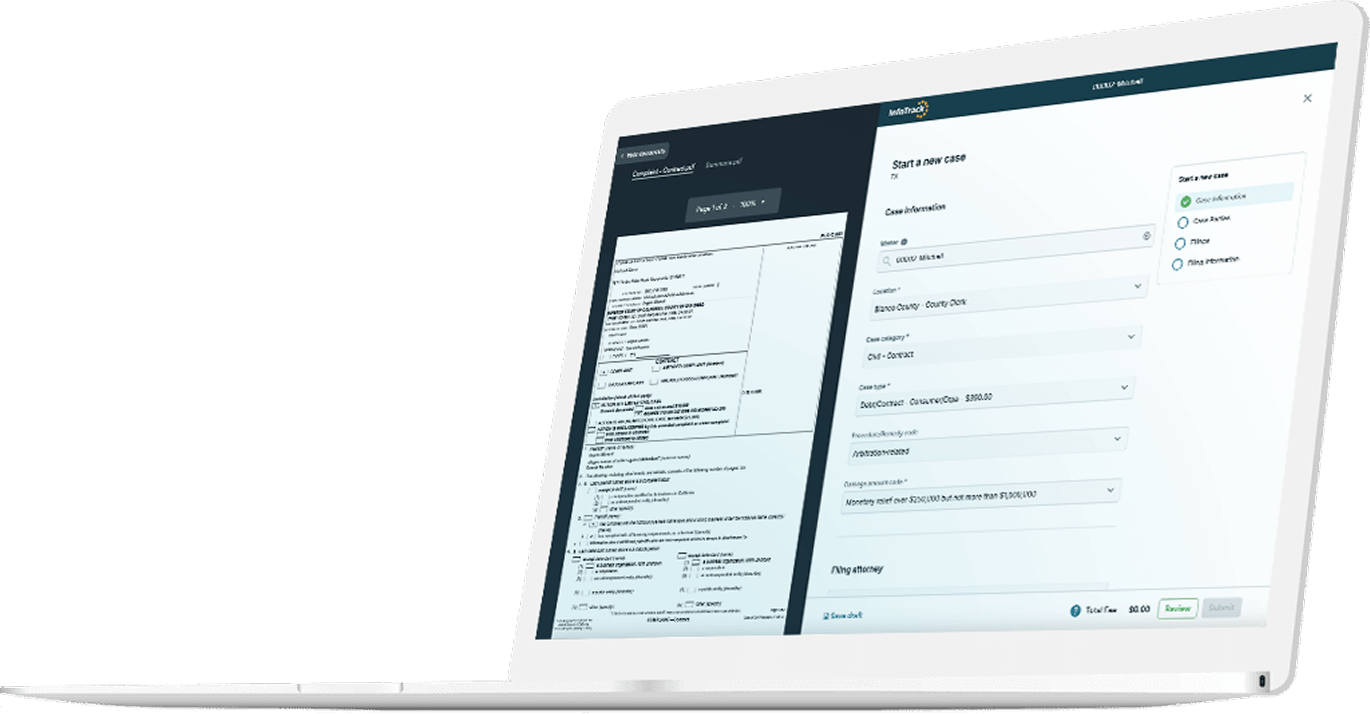
More and more tools that support litigation work are incorporating AI to help legal teams save time, so it’s important to understand how each tool works, and to ensure the benefits outweigh the risks. InfoTrack uses AI to read the documents you upload and autofill 95% of filing form fields, reducing manual work for your team and the risk of human error in data entry. As a result, our clients see rejection rates under 5% — about half the industry average.
Sign up for an InfoTrack account today to see how the right AI-enabled tech can help your team file more efficiently.
People also ask
Can AI predict juror behavior?
Not reliably. AI can analyze a juror's public data and flag patterns that suggest how they might lean, but decades of social-science research show the link between measurable traits and actual verdicts is weak. The honest framing is that these tools generate informed hypotheses about a juror, not predictions you can bank on.
Can AI detect juror bias?
It can surface signals — public posts, affiliations, or statements that hint at a strongly held view — that a lawyer might otherwise miss. What it can't do is reliably tell you how those views will play out in deliberation. Nor can it tell you whether someone has had a change of heart since their last impassioned Facebook post.
Are AI jury selection tools accurate?
It depends on what you're measuring. When it comes to gathering and organizing public data on a full panel, they're phenomenally useful and fast. As for predicting verdicts, the evidence is thin and early. A few head-to-head tests are promising, but vendors are largely controlling the messaging around this. Treat the research as strong and the prediction as unproven.
Will AI replace jury consultants?
AI will more likely reshape the work than end it. AI has already automated the data-gathering and profiling that once justified a large share of a consultant's fee, and simulation tools now offer a cheaper alternative to the traditional mock trial — which is why smaller firms are adopting them. But reading a room, interpreting a hesitation, and building trial strategy remain human work, so the likely future is consultants incorporating AI into their work, not being replaced by it.
Is AI jury selection ethical?
It can be, with care. ABA Formal Opinion 517 makes clear that using AI in jury selection isn't prohibited — but the lawyer stays fully responsible for the outcome and can't follow a tool's recommendation into an unlawful strike. Used with human oversight, vendor scrutiny, and a clear record for every decision, these tools are ethically defensible.