
Legal AI is booming, with new specialized AI tools targeting nearly every step of the litigation. The biggest challenge now isn’t finding an AI tool that’s built for law but figuring out which tools are best suited to your firm’s needs.
According to a 2026 report from 8am MyCase, more firms are currently using general-use tools (46%) than legal-specific AI tools (34%), so there’s clearly room for firm decisionmakers to learn more about the tools available, especially if you plan to develop firm-wide policies to govern AI use and define which tools are approved for use.
Where you decide to invest your technology budget will ultimately depend on which routine processes are currently taking up most of your team’s time, and which complex processes are most in need of improvement. But once you know what your needs are, you should learn more about the tools on the market, what tasks they can support, and how they compare.
What kinds of AI tools are available for legal professionals?
When you think of AI, large language models (LLMs), like ChatGPT or Claude, are probably the first tools that come to mind. While many legal teams use general-purpose LLMs, a growing number of legal-specific AI tools are designed to support tasks across the litigation process, from client intake to jury selection to billing and invoicing. These tools are usually built on those same general-purpose LLM models, but with an added layer that tailors data sources and responses to a legal team’s needs.
Some of these tools narrowly focus on just one piece of the process, while others seek to support multiple litigation tasks or purposes. A multipurpose tool may seem to offer more bang for your buck, but depending on your team’s needs, you may find that a more specialized tool ultimately saves more time and money than one that purports to do it all.
Multipurpose legal AI tools
These tools support are built to handle a wide variety of legal tasks in one platform. A user can get AI support in researching case law, reviewing and summarizing documents, analyze large amounts of data, and running litigation workflows all in one place, instead of using several different tools and applications for a single matter.
Harvey
Perhaps the best-known legal AI platform, Harvey is primarily built for large firms with diverse needs. Harvey can help with case law and statutory research, document and contract drafting, contract review, document analysis, and litigation analysis. It is especially useful for generating document summaries and tabular reviews to support due diligence, discovery, and regulatory compliance. Firms can also use Harvey’s Vault feature to organize and store firm knowledge, and its agentic workflows can help automate complex, repeatable processes. LexisNexis law content and Shepard’s Citations are integrated within Harvey as Ask LexisNexis, allowing users to research federal and state case law, statutes, administrative codes, and agency decisions in the same workspace.
Legora
Harvey's closest competitor has similar strengths, but Legora's key differentiator is its collaboration features, which allow legal teams to work on the same matter together when drafting in its editor, running Tabular Reviews, and building workflows. Its Portal also lets firms share work product and reviews directly with clients instead of sending files by email.
August
August helps solos as well as small to mid-sized firms handle document-heavy work like contract review, due diligence, and discovery preparation. Firms can also configure its AI agents to follow their own playbooks and practices for a more customized experience. Small teams can start using August through a self-service sign-up and get many of the capabilities of an enterprise solution like Harvey or Legora without an extensive rollout.
AI Research tools
Legal AI research tools let lawyers ask legal questions in plain language and get answers that include citations of relevant case law and statutes. These tools can also summarize lengthy opinions or statutes, and check whether a cited case is still good law, as well as analyze and review uploaded documents. Research tools that offer AI agents can run multi-step research tasks on their own and draft documents based on the findings. These tools are constantly improving, but none can claim 100% citation accuracy, so you should always check citations retrieved or documents drafted by one of these tools.
CoCounsel Legal
Built on Westlaw and Practical Law, Thomson Reuter’s comprehensive legal research database, CoCounsel is best known for its case law and statutory research capabilities, including Deep Research — its agentic AI research tool that autonomously plans, executes, and synthesizes multi-step legal research. CoCounsel also integrates Westlaw's KeyCite citation intelligence in its legal workflows, and supports regulatory research, document drafting, contract reviews, and document analysis and summaries.
Lexis+ with Protégé
Built on the comprehensive LexisNexis library of U.S. federal and state case law and statutes, as well as strong secondary sources, Lexis+ with Protégé validates citations with Shepard’s and can pull analytics from Lex Machina, LexisNexis's litigation analytics platform. Otherwise, the tool’s primary features are similar to CoCounsel’s, including document review and drafting. While Lexis+ with Protégé, has some contract review capabilities, CoCounsel is generally considered stronger at contract review tasks.
Bloomberg Law AI
Bloomberg Law’s research tool is built on its library of federal and state law, as well as Bloomberg’s news, regulatory updates, and market intelligence, and checks citations with BCite, its proprietary citator. While its document review and drafting capabilities are more limited, Bloomberg Law has some of the strongest docket and litigation data among legal research tools, and its AI Assistant includes a Deep Thinking mode for complex, multi-step research. In 2026, Bloomberg also announced new features including BLAW AI, Workspaces, and AI agents, but because these features are newer than competitors’ offerings, users who prioritize agentic capabilities may prefer a more proven tool.
Vincent (vLex)
vLex, the legal research company and online law library that boasts the largest global legal database in the world with over one billion legal documents from more than 100 countries, was bought by Clio in 2025, and now powers the platform’s AI offerings. That impressive library makes its AI legal assistant, Vincent, a strong choice for multi-state and international research needs.
Paxton
Intended primarily for solo practitioners and small-to-midsize firms, the Paxton AI assistant offers similar research, document analysis, and contract review capabilities to the other tools. Its citator is AI-driven, not created by human editors like the standard Shepard’s and KeyCite, and its proprietary research library lacks the editorial enhancements and secondary sources of other major research platforms, so the offerings don't run as deep as some competitors.
AI contract review tools
Most of the multipurpose and research tools on the market offer contract review capabilities, but a dedicated contract review tool can be a worthwhile investment for teams that handle contracts at a high volume. AI contract review tools can read contracts and help spot risks, missing terms, and clauses that depart from a firm’s preferences. They can redline contracts, provide fallback language, and compare terms against playbooks. While these tools can speed up review considerably, you should still check their suggestions.
Spellbook
Spellbook offers AI contract drafting and review that runs as an add-in within Microsoft Word, allowing legal teams to get AI support without leaving their primary drafting tool. Spellbook can redline, identify missing or risky clauses, and draft new clauses — even whole sections — from a prompt, all within the Word file. It’s also known for its market benchmarking tool, which checks contract terms against typical agreements to help users determine how reasonable a potential contract term would be considered.
Luminance
This contract platform was originally built to manage M&A due diligence, so its legal AI can read and analyze documents in large volumes. While it offers similar features to Spellbook, it is stronger at clause extraction and bulk review and Spellbook is generally preferred for drafting tasks. Luminance is often better suited to big law firms or large teams and can feel like more tool than a small firm needs.
Kira (Litera)
Purchased by Litera in 2021, Kira is one of the longest-established due diligence contract analysis tools on the market. It is especially good at extraction, with a large library of “smart fields” that can be used to find and extract specific provisions. Users can also create their own custom fields and use its relatively new generative AI capabilities to summarize and respond to questions about documents. Kira is often preferred by Big Law and international firms for its ability to handle high-volume requests, while it lacks the drafting and redlining capabilities small firms look for.
LegalOn
LegalOn works inside Word and offers ready-made, attorney-written playbooks that can flag missing, unusual, or risky clauses in common agreements. The playbooks are customizable, so firms can still get some of the benefits of a bespoke playbook without having to build their own from scratch. LegalOn is mainly aimed at in-house legal teams, but small firms handling similar contracts may also get value from the tool.
AI discovery tools
AI tools are especially well-suited to the high-volume work of discovery and can save legal teams hours and hours of time spent collecting, reviewing, and surfacing relevant documents, emails, chats, and other data. AI discovery tools can read documents, summarize them, explain why they matter, and answer questions about the evidence.
Relativity (aiR)
Relativity is widely considered the industry leader for large and complex litigation. Its generative AI suite, aiR, reviews documents for relevance and makes first-pass calls accompanied by written explanations. It can also flag privileged documents and build case summaries and timelines. Relativity is highly customizable, which also makes it complex to use, so many Big Law firms rely on trained specialists to run it.
Everlaw
Everlaw supports the full discovery process, from uploading and processing data to trial preparation, all in a user-friendly browser interface. Its AI assistant summarizes documents, answers plain-language questions, helps code documents for review, and analyzes depositions. Its Storybuilder tool organizes key evidence into timelines and case narratives. It’s Relativity’s primary competitor, generally seen as better for deposition analysis and easier to use for smaller matters, while still offering powerful tools for complex cases.
DISCO (Cecelia)
DISCO’s generative AI assistant, Cecilia, supports the same core discovery tasks as Relativity and Everlaw, and is bundled with DISCO’s deposition and timeline tools in one all-inclusive platform. It’s mostly used by corporate legal departments and law firm litigation teams that want powerful automation capabilities but don’t need Relativity’s customization options.
Reveal
Reveal’s eDiscovery and investigations platform has acquired Logikcull, a self-serve discovery tool designed for small matters, and Brainspace, an analytics tool. Analytics are Reveal's biggest strength: It uses AI to cluster documents, map communications, and find patterns, making it a popular choice not just for litigation, but for internal investigations and regulatory work, too. Its generative AI tool, Ask, answers questions about documents and provides summaries with links back to the original sources, alongside more traditional predictive coding.
Nextpoint
Nextpoint is designed for small and mid-sized law firms without a litigation support team. It manages document collection, review, and production, and is focused on getting cases to trial, with tools for managing deposition transcripts, organizing exhibits, and preparing evidence for the courtroom. It uses AI to search and summarize documents, but its appeal is less about cutting-edge technology than its ease of use for stretched-thin legal teams.
AI jury selection tools
There are now AI tools available that can help legal teams research jurors, evaluate their likely biases, and support the selection process. Some newer tools can even simulate juries, using AI “jurors” to test how an argument might land at trial and predict possible verdicts. Still, the research behind juror scoring is limited, and the ethics of AI jury selection can be fraught, so also remember that you remain responsible for your team’s decisions and making sure your use of technology does not violate court rules or ethics guidance.
Momus Analytics
Momus Analytics is a jury selection platform that scores prospective jurors on how favorable they’re likely to be to one side of a case using data analytics and behavioral science. It draws from publicly available data and uses a proprietary algorithm, updating scores as new answers come out during voir dire. Momus is aimed mainly at trial lawyers handling high-stakes cases and, like other algorithmic scoring tools, raises some ethical concerns about potential bias.
Jury Analyst
Jury Analyst combines traditional jury consulting with legal AI, building profiles of likely jurors based on demographics, attitudes, and predicted biases, and helping attorneys develop voir dire questions tailored to their case. Its advanced options include AI jury simulations and virtual focus groups, letting trial teams test how different arguments might land with a jury ahead of time.
Vijilent
Vijilent provides some of the benefits of jury consulting without hiring a full consulting team. It uses AI to collect and organize a person’s social media and other public data and turn it into a profile it calls a DataPortrait, which can reveal attitudes, interests, and potential biases. It also pairs AI with trained human researchers to make sure each profile belongs to the right person, reducing the risk of error.
Practice or case management platforms
You firm may already use a practice management system (PMS) or case management system (CMS), which acts as a central system for many firm operations, including matter tracking, deadlines and calendaring, and document management, as well as time capture, billing, and client management. Not all practice or case management platforms incorporate AI, but many now do. Popular platforms include InfoTrack integration partners Clio, MyCase, Smokeball, Filevine, Neos, and LEAP.
Clio
Clio's AI assistant, Clio Duo, summarizes matters and documents, drafts copy, and can answer plain-language questions about a case. It can also support time entry and billing by using information already stored in the firm’s account. Since acquiring vLex in 2025, Clio has also incorporated Vincent’s AI-powered research and document analysis capabilities within the same platform.
MyCase
MyCase IQ, a set of AI features within MyCase, can summarize documents and draft client messages, saving time spent on everyday communications.
Smokeball
Smokeball’s AI matter assistant, Archie, can answer questions about cases, and summarize and draft documents using matter data. Its AutoTime feature records the work lawyers do in the background and automatically generates time entries to help capture more billable hour.s
Filevine
Filevine’s AI layer, LOIS, can review and summarize documents, build case timelines, analyze deposition materials. Its facility with analyzing medical records and valuing settlements and makes it an especially popular choice among personal injury firms. Ask LOIS performs the same basic functions as most legal AI assistants: answering questions and analyzing and drafting documents, but can also take action on a case, like setting tasks or moving deadlines.
Neos
NeosAI can summarize case files, analyze and compare documents, help generate documents, and answer questions about the case data stored in Neos. Like Filevine, its features are geared towards the unique needs of personal injury firms that frequently work with medical records and chronologies.
LEAP
LEAP’s Matter AI assistant answers questions, summarizes and compares documents, and helps to generate first drafts. LEAP has its own automated time capture tool (also called AutoTime, like Smokeball’s) to track and record time from the billable work users are doing. LEAP’s most distinctive AI feature is LawY, an AI research assistant that produces answers that can be checked and verified by qualified lawyers on request.
Legal workflow automation tools
These tools allow legal professionals to automate repetitive processes like client intake, request handling, or approvals to save time and manual work. Workflows are usually built through no-code drag-and-drop builders and designed to ask the right questions at each step, apply firm rules, generate documents, and route work according to predetermined routines and standards. Many of these tools now use AI to extract information from documents, flag issues, and draft content to support automated workflows.
BRYTER
BRYTER combines the rule-based logic of workflow automation with built-in AI that can extract data, review documents against rules, and draft or redline clauses without the need for user-entered prompts or code.
Neota Logic
Neota Logic is known for its reasoning engine, which can handle especially complicated rules and calculations. Neota has added AI to its rule-based workflows to support tasks like document analysis and data extraction.
Checkbox
Checkbox helps legal teams build tools for intake, document generation, decision-making, and workflow management. It uses AI in combination with its rule-based logic for routine tasks like sorting and responding to requests, processing documents, and routes complex tasks to the right legal professional.
Josef
Josef offers a no-code platform for rule-based automation, which lawyers can use to build simple tools like intake forms, chatbots, and document generators that they can offer to clients as self-service products. Its generative AI product, Josef Q, uses Claude to turn team policies, regulations, and other content into question-and-answer tools that allow team creators to review and moderate answers.
Gavel
In addition to its no-code automation platform, Gavel offers Gavel Exec, an AI tool that reviews, redlines, and drafts contracts in Microsoft Word
How other legal tools are using AI
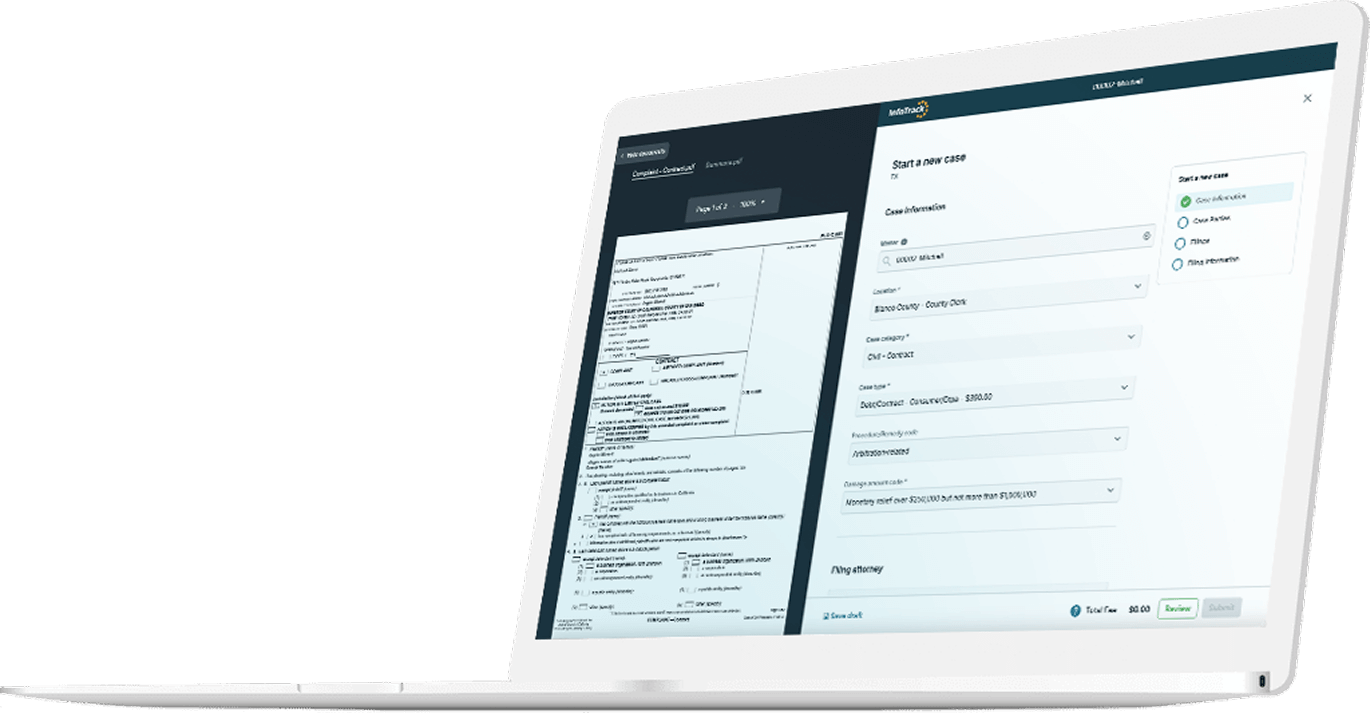
Not every legal AI tool started out as an AI tool. While some tools like Harvey, Legora, and Spellbook were explicitly built on top of LLMs as AI-native products, many established legal tech platforms have adopted AI capabilities and use them to enhance their existing products. InfoTrack, for example, uses AI to read your filing documents and fill 95% of form fields automatically, reducing rejection rates to under 5% — half the industry average.
When choosing the right tools for your firm, don’t let AI buzz distract from the true purpose of legal technology: saving legal professionals time and manual work so they can spend more time serving clients. The right tool isn’t necessarily the newest AI platform, but more and more, the right tool is using AI to get even better.