.png?width=765&height=430&name=Blog%20header%20templates%20(33).png)
Filing requires the utmost attention to detail while under strict deadlines — often while juggling multiple matters at once — and a single mistake could put the outcome of an entire case in jeopardy.
“Court filing...[is] one of the highest anxiety workflows that we encounter in our profession,” said paralegal and legal educator Kelli Radnothy in a recent webinar hosted by InfoTrack. “We don't want to hit submit because we're terrified we didn't do everything right, we didn't check off all the boxes.”
Adding to the stress of eFiling are the complex state and federal rules filers must know about to submit accurate filings.
"The rules...can really be nuanced jurisdictionally, not just by state—by county, by judge,” added legal educator and paralegal Kristine Custodio Suero. “So that can cause a lot of miscommunication, misunderstanding, and can be extremely problematic.”
Understanding the differences between state and federal court filings, as well as common mistakes to avoid and best practices for an error-free filing workflow, can help take some of the stress out of filing.
How does filing in U.S. state courts differ from federal courts?
In short, filing in state courts can be a fragmented process governed by widely varying and ever-changing local rules, but with more flexibility than you’ll typically have when filing in federal court. Filing in federal courts is more standardized and unified, but those standards can be more rigid and exacting, requiring even more precision and attention to detail.
State Courts
State courts are subject to a wide array of state and local jurisdiction rules, which can vary by county, court and even judge. Deadlines, procedures, terminology and mechanics of service can all fluctuate from jurisdiction to jurisdiction. And on top of all that, a network of multiple eFiling portals and vendors adds even more complexity.
To submit a successful filing, you’ll need to be adaptable and constantly check and verify your work to ensure compliance with local rules.
“No matter where we're at in our career path, we are constantly learning,” Radnothy said. “We have to embrace that because if we don't, we will not succeed in all of these different jurisdictions.”
“It's those more local rules—the more nuanced or chamber rules—where we really have to...read between the lines, and that causes stress in itself.”
For example, dedicated eFilers may be surprised to find that in some rural areas, not only is physical filing required, but the only way to learn the status of a filing is to call or physically visit the clerk.
With the complexity of so many varying rules and standards, though, often comes some flexibility. Some states are more strict than others, but in many states you may be able to get deadlines extended or otherwise receive some leeway with filings that you will rarely get in federal court.
Federal courts
Compared to state courts, federal court filing is far more consistent, with centralized rules and the unified Case Management/Electronic Case Files (CM/ECF) system for eFiling. Federal electronic communication makes it easier to stay up to date with a case, as opposed to the patchwork of communication standards in state courts. Federal courts may also move faster in some case types, but timelines vary widely by jurisdiction and caseload.
“Federal court emphasizes precision and consistency,” Custodio Suero said. And with that precision can come higher expectations.
Deadlines are stricter in federal court. Filings must be completed by the deadline with almost no flexibility. For example, technical problems usually won’t justify an extension, unless the issue is with the CM/ECF system itself. Federal courts also place strict file size limitations on filings, which could require you to fragment larger documents into multiple pieces that must be accurately labeled. And federal filings may require more documentation overall, depending on case type.

What are the most common court filing mistakes in the United States?
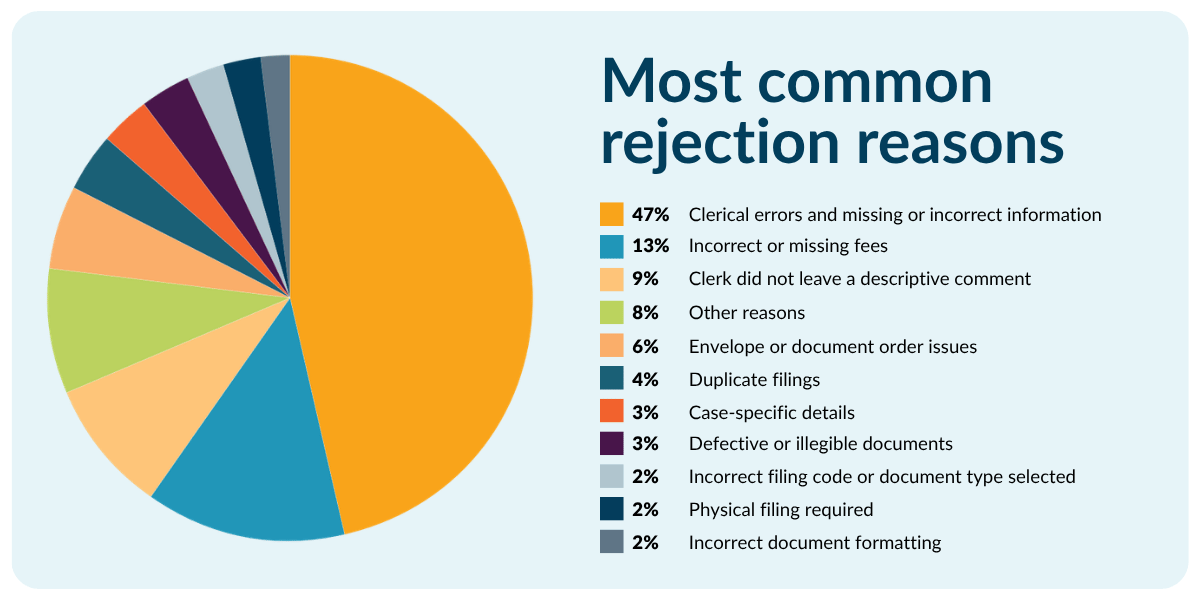
Filing errors usually come down to the details. In our most recent Rejection Reasons Report, we found some of the most common causes of rejections were:
- Clerical errors and missing or incorrect information
- Incorrect or missing fees
- Envelope or document order issues
- Duplicate filings
- Defective or illegible documents
- Incorrect filing code or document type selected
- Incorrect document formatting
To avoid rejections, you need to maintain your attention to detail, remain calm under the pressure of strict deadlines, communicate proactively with clerks and counsel, and exercise good judgement about when to escalate issues. But building a reliable court filing workflow should be your first step in preventing errors when filing in any state or federal jurisdiction.
How to build a court filing workflow for any jurisdiction
Building an effective court filing workflow is essential for reducing errors, improving efficiency, and ensuring compliance with jurisdictional rules.
1. Start with a project plan
At intake, start mapping out all the elements of the case including:
- The scope of the case
- Identification of issues
- Key evidence
- All parties involved, including witnesses, experts and opposing counsel
- A structured timeline including all deadlines, depositions and court mandated milestones
At this stage you should determine a central depository for all case documents, and assign roles and responsibilities within your team.
“I'm constantly mapping from the very moment I am assigned a case,” said Custodio Suero. “We need to make sure that if the mission is to make sure that the client's case is moved forward and progressed timely and efficiently, that I'm doing that, that my due diligence in that intake and document preparation process happens at the get, from the beginning.”
2. Use templates and checklists for quality control
Using templates for pleadings, motions, affidavits and other common documents — especially if you utilize macros or other codes to pre-fill elements — can save your team time in the drafting process that they can put to better use checking local jurisdiction rules to ensure compliance.
“In all of our cases, we can use these templates to help us along and facilitate our cases," Custodio Suero said. “Though there are nuances within the departments and the different courts, when you attack those early, that can really help your workflow.”
Checklists, meanwhile, can help your team remain on schedule and meet all requirements at each stage of the case. Think of checklists as safety nets which can catch common errors and reduce the likelihood that a filing will be rejected.
Peer review and standardized naming conventions can also help catch mistakes before they become a bigger problem.
3. Use technology that reduces errors
Sometimes technology can do more to ensure accuracy and efficiency than any number of checklists can. Working with the right partners can be one of the most impactful parts of your new filing workflow.
“I know I've leaned on partners like InfoTrack to be like, hey, ‘I need to serve somebody in this rural county in a state I've never practiced in,’” Radnothy said. “’I'm going to rely on you for your expertise and the mastery of what you've done’... And then I can really focus on what the judge-specific preferences are in that jurisdiction because I've partnered with somebody who excels in the service space, and I feel confident.”
“It is almost essential now as a modern paralegal that we rely on the resources that are on our periphery in order to make things happen efficiently.”
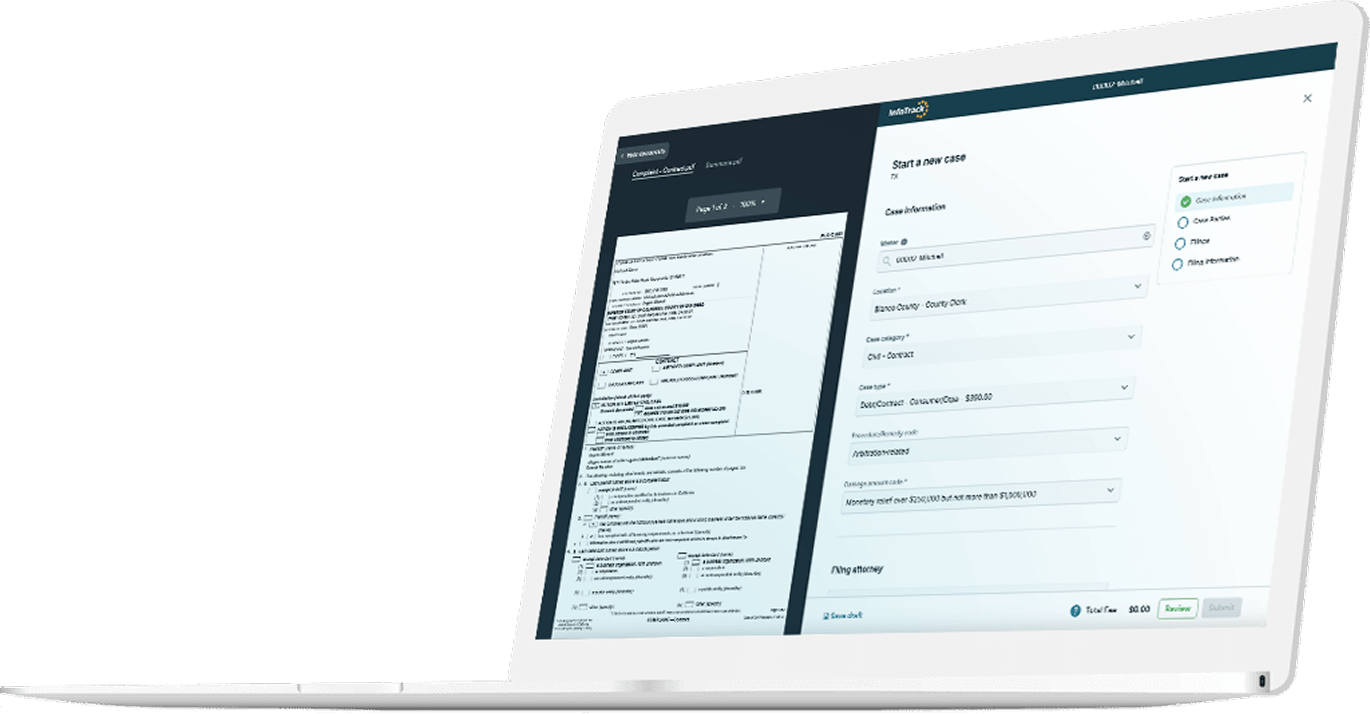
InfoTrack reduces rejection rates by reading your uploaded documents and auto-filling 95% of fields, so filings can be submitted in under 30 seconds. Court-specific validation also catches jurisdiction errors before you submit. As a result, our clients see rejection rates under 5%, against an industry average of around 9%.
Create you free account to see what InfoTrack could do for your firm.